
Affiliate disclosure: This review contains affiliate links. If you buy through them I may earn a commission at no extra cost to you. No brand pays for review coverage.
Quick Specs
| Spec | Value |
|---|---|
| Core | Standard polymer honeycomb |
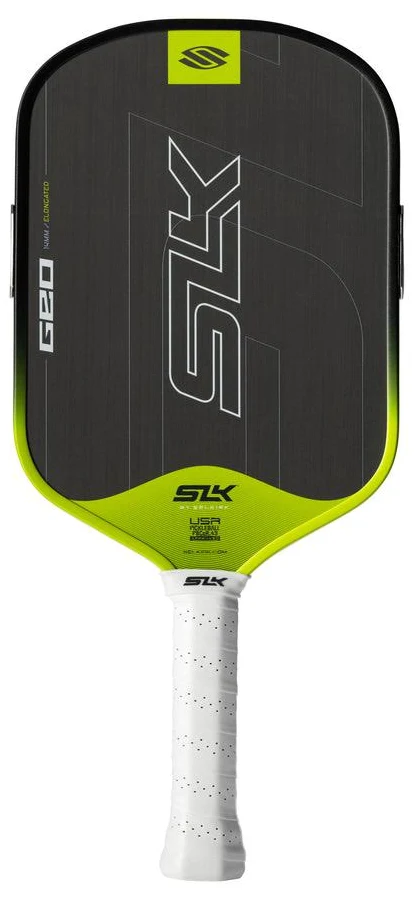
| Face | T700 raw carbon fiber |
| Thickness | 16mm |
| Shape | Widebody and Elongated |
| Price | See Selkirk.com for current pricing |
| Warranty | Selkirk standard warranty |
| Where to Buy | Selkirk.com — enter code EP-NSMYTH as a discount code at checkout |
The Short Version
The Geo puts T700 raw carbon fiber in the hands of developing players without the price tag of a premium paddle. The polymer core keeps the construction straightforward and budget-friendly; the carbon face is what makes it worth considering over cheaper composite options. For 2.5–3.5 players who play several times a week and want to start developing spin-based shots, this is a reasonable starting point. It’s not a paddle you’ll need at 4.5, but it’s not supposed to be.
Feel & Control
A 16mm polymer core gives the Geo a soft, forgiving feel that suits developing players. Dwell time is adequate — the ball sits on the face long enough that drops and dinks are manageable even when technique isn’t fully dialed in. The paddle doesn’t pop back hard on soft shots, which makes the kitchen game approachable while you’re still building touch.
The carbon face is slightly firmer than fiberglass, which gives you more feedback on contact quality compared to the Valkyrie. You’ll notice the difference between a clean center hit and an off-center mishit — that feedback is actually useful for developing consistency. The MOI Tuning System provides basic stability on off-center hits; mishits still travel reasonably close to target.
Resets are straightforward — the polymer core absorbs pace well, and the paddle doesn’t fight you when you’re trying to take speed off the ball. For players at 2.5–3.5 who are learning to neutralize hard attackers, the paddle is forgiving enough to make those resets executable.
Power & Pop
The polymer core limits how much pop the Geo generates compared to a foam core option like the Dauntless. Drives have decent pace for recreational and lower-level competitive play, but this is not a power paddle. Developing players will have enough firepower to play effectively; they won’t be overmatching anyone with raw pace.
Serves have adequate velocity to work with. At 2.5–3.5, you’re not going to win points with pace alone regardless of paddle — the Geo gives you the right amount of power for the skill level it’s designed for, and adding more would just create overhitting problems.
Spin
The T700 raw carbon face is the Geo’s standout feature at this price point. Most paddles in this budget range use fiberglass or basic composite faces that barely grip the ball. The raw carbon surface provides real bite — you can generate meaningful topspin on drives, shape serves with spin, and execute topspin drops that clear the net with margin and dip into the kitchen.
For players actively working on adding spin to their game, this is a legitimate upgrade over fiberglass. The Valkyrie’s fiberglass face will not give you the same spin capability; if developing a spin-based game is a priority, the Geo is the right choice between the two.
Raw carbon texture will wear with heavy outdoor use — it’s not the most durable surface technology available, but at this price point it’s competitive with what comparable paddles offer.
Who It’s For
This paddle is for 2.5–3.5 players who have moved past complete beginner stage and want to start developing spin-based shots. If you’re playing 2–3 times per week in open play or community leagues and your current paddle feels limiting — particularly if you want to work on topspin serves and drops — the Geo gives you those tools without overspending.
Skip the Geo if: you’re a complete beginner still learning basic ball control (the Valkyrie’s larger sweet spot and softer feel will keep you in rallies longer while you develop fundamentals), or if you’re above 3.5 and starting to play competitively (the Dauntless gives you foam core responsiveness that’s more appropriate for that level).
On shape: widebody if you prioritize forgiveness and net play; elongated if you want extra reach on serves and baselines shots. Both use the same core and face, so the choice is purely about playing style.
Verdict
The Geo delivers its main promise — T700 raw carbon fiber for developing players at a budget price — cleanly. The spin capability is real, the 16mm polymer core keeps control manageable, and the forgiveness is appropriate for 2.5–3.5 level play.
It’s not trying to be more than it is. Once you’re playing at 3.5+ consistently and competing, you’ll want to look at the Dauntless for foam core performance or the ERA Power for pro-level construction. But as a step up from a beginner paddle that gets you real carbon fiber spin capability, the Geo is a solid choice.
Enter code EP-NSMYTH as a discount code at checkout at Selkirk.com.